Saturday, October 29, 2011

Miracle Tree: What Indian Women Need

Yesterday I wrote a blog on the current status of women's health in India. The blog http://stellasmusings.blogspot.com/2011/10/sickly-truth-half-of-indias-women-are.html is about how over 50% of Indian women suffer form anemia and malnutrition - a fact revealed by a  recent report.

After the blog was published, a friend called Olanike from Kaduna, Nigeria asked me if I knew miracle tree (moringa oleifera) which could cure anemia. Executive Director of Women Initiative for Sustainable Environment in Kaduna, Olanike often advises women in her community to use the miracle tree to build blood, thus fighting anemia. And that is how I came to write this blog.
Moringa Oleifera/Miracle Tree: Over 50% of women in India suffer from anemia and consuming parts of this tree can help build blood and restore their health

Miracle Tree or drumstick or Sanjna is a tree widely available in India. In fact I have never lived in a house that didn't have at least 1 miracle tree in its garden. And I have always eaten, not just its beans/pods (the 'drumsticks'), but also its leaves and flowers which you can eat in different ways, are quite tasty as well,beside being high in nutrition. 

Friday, October 21, 2011

Basil - Grow, Munch, Enjoy !


Its sometimes shocks me to know that most of my friends in India don't know how to eat Basil. In big cities, a few boutique-type vegetable shops do sell basil, but the buyers are all restaurateurs.

It shocks me because I have eaten lemon basil as long as I can remember. And frustrated with 'no basil' situation, I took to growing them a few years ago. Turns out, they are extremely easy to grow! Doesn't need more attention than what you give to a Tulsi/sacred basil plant.

The common way to basil is of course as a flavor add on or as a salad leaf. So, one day I thought of trying an 'Indian' way - fry the leaves. The result was quite impressive! The leaves were thin and therefore cooked quickly. With each bite, you get the strong flavor filling your mouth, your nostrils, while the fried leaves, coated with corn flour, tempts you to snack on.


Another experiment that I did was cooking basil with tiny local fish. Clean the fish, mix them with a thick paste of turmeric, salt, ginger, green chili and garlic. Finally, add a liberal amount of finely chopped basil and  and cook in steam . The taste is so good, you will not forget for quite some time!

Another weekend is here. How about flavoring it with a bit of basil - the oriental way?

Monday, October 10, 2011

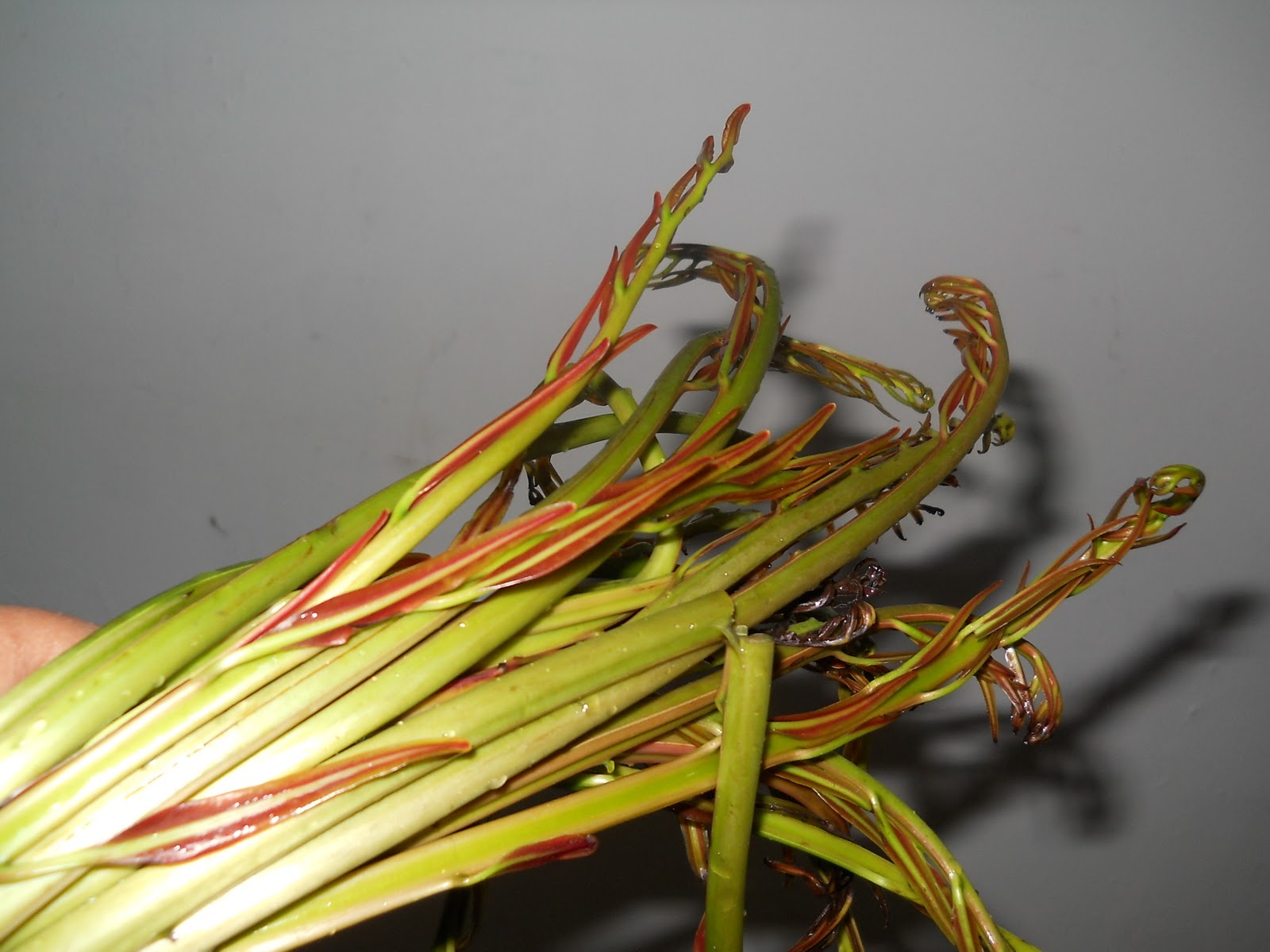
Fern - Food For A Smile!


Ferns are in demand as a home decor. But if you cook the right one, it can also bring a big smile on your face. The aroma and the taste is so wonderful, I call it my happy dish - one that always lifts up my sagging spirit!.

Edible Fern, popularly known as 'Dheki' or 'Akoor'


Fern is quite popular in the North east India. The variety that we find there - quite in abandon - is the Pako/fiddlehead fern. But in Goa also, I have been lucky to find it, though only in monsoon. The variety is the swamp fern, and goes with the local name of 'akoor'. Sadly, many people, locals included, don't seem to know how to eat it :(

Cooking the fern is simple: chop them into tiny pieces. Chop some garlic cloves and fry them a spoonful of oil, add the fern now and fry until it goes tender. You can, also use cumin seeds for the seasoning, but its garlic that really brings out the flavor of the fern. Remember, you must wash the fern thoroughly before cutting. Because, once cut, a slippery substance starts to ooze out, making it difficult to wash it later. 

Want to get over your Monday blues? Try this happy dish! 


Sunday, October 9, 2011

Vegetarian? Here's A 'Bird' You Can Eat!

Everyone knows a hummingbird. But have you ever seen a hummingbird flower? You did? Great! Now, have you ever tried eating one? There! Gotcha!


Hummingbird or 'Bok' - one of the tastiest flowers ever! Photo credit:
3Point141@gmail.com


The hummingbird flower is one of the tastiest flowers ever! In fact its been over 3 years since I ate my last, but I can still feel the taste!  


Before you eat a hummingbird,remember 2 things: 1) A fully grown, about -to-bloom bud will taste better than one on full bloom. 2) Dig your fingers inside the flower and remove the thin, green stalk that you find in between the petal. That is a bitter, inedible part.


If you like your food in its original flavor, like I do, then chop the flowers in small or medium pieces and just saute with a pinch of salt and turmeric, if you will. That's it!


But if you want a more exotic dish, then get a handful of rava (semolina) powder. Make a thin paste with water, dip the flower and dip fry in oil. You can eat it as a snack or as a side dish at lunch/dinner.


The hummingbird grows all year through and you can eat it anytime! And when you do that, no real birds will be hurt :)

Lily Pop , Anyone?

Water Lily aka 'Bhet phool' aka  'Shapla'
Almost every family in the north east India owns a pond. And gracing almost every pond is a family of Water Lilies. White, red and purple, the Lilies are called 'Bhet phool' or 'Shapla'(which is also the national flower of Bangladesh) and are a great attraction among local kids. The reason? The pop seeds of the Lilies, or, as we kids called them 'Lily Pops.' 


Its very easy to make Lily pops. The seeds in the Lily pod look very much like mustard seeds. Dry them in the sun and fry them later in a vessel until they pop. Don't forget to put the lid on. Lightweight and munchy, they are quite a delight! And the fact that its a free treat adds to the fun :)


The stalks of the Lily is also edible. Peel off the outer fiber and cook the inner, softer, fleshy part like you would cook a zucchini or a ridge gourd (tori/turai). You can cook them as a separate dish or as an add on. The taste is unforgettable!


So, go ahead, give yourself a free gift - a bowl of Lily pops! 

Saturday, October 8, 2011

A Mouthful of Colors!

Impatiens Balsamina aka Rose Balsam aka Dopati aka Gauri Shankar.

Red, purple, white, pink, mauve and orange - they come in all colors, are easy to grow and are a joy to look at.But what most people don't know is that they are also edible. Yes, I am talking about Impatiens Balsamina aka Rose Balsam aka Dopati aka Gauri Shankar.

There are so many ways one can eat a Rose Balsam! My personal favorite is what my mother makes - the 'Kofta'! Make little balls of the petals, dip them in a batter of your choice (chickpea powder or rice powder or corn flour), shallow fry and then cook them in a curry with sliced potatoes. 

The other way is to add the outer petals to your salad. And then you can also dry the seeds of rose balsam, grind them and add a pinch to your tea. But, as I said, nothing beats the kofta curry!

Go ahead, add a dash of colors to your palate today!

Sawtooth - The Magic Appetizer!

It smells great. And when added to your dish,  it will get an aroma so heavenly, you will drool all the way to the dining table. A little spiky, a little pricky and very, very aromatic, this is Sawtooth, one of my most favorite herbs!


Sawtooth, also known as Thorny/Pricky Coriander, Bar Dhaniya, Ban Dhaniya, Pak Chi Pharang and Ngo Gai


Found across North east India, I have never seen it anywhere else outside the region. In fact, even in the north east, it's a rare sight these days. Is this because of the changing climate?